How to Choose Interior Paint Colors for Your Phoenix Home
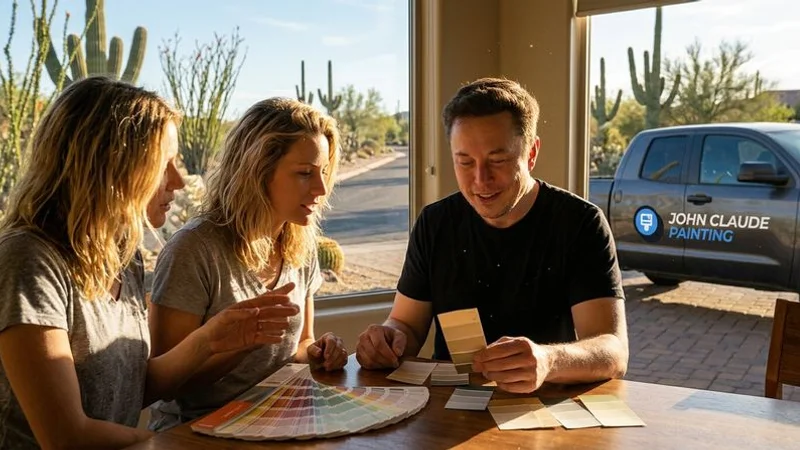
Choosing interior paint colors for your Phoenix home involves much more than picking a pretty shade from a fan deck.
We have seen countless homeowners struggle because they didn’t account for the unique intensity of the Sonoran Desert sun.
Arizona’s natural light affects wall colors differently than light in the Midwest or East Coast does.
Our team at John Claude Painting knows that a gray that looks sophisticated in Seattle often turns completely blue or lilac under the Phoenix sun.
You need a strategy that accounts for light reflectance, room orientation, and the architectural style of your home.
We will break down the science of desert light and share the exact palettes that are working right now.
Let’s look at how to get this right the first time.
Understanding the Physics of Phoenix Light
The sunlight here is not just brighter. It is warmer and more intense.
We measure light intensity in lumens, and Phoenix averages some of the highest lumen counts in the United States.
This intensity washes out subtle colors.
A soft, whisper-gray that looks elegant on a Pinterest board often disappears completely on a wall here, leaving you with what looks like unprimed drywall.
The Impact of Light Reflectance Value (LRV)
Every paint color has a Light Reflectance Value (LRV) on a scale of 0 to 100.
We use this number to predict how a color will react to the desert sun.
0 is absolute black, and 100 is pure white.
In Phoenix, we typically recommend choosing colors with an LRV between 55 and 75 for main living areas.
Going higher than 85 in a room with large windows can create a painful glare during the afternoon.
Choosing a color with an LRV below 45 often makes a room feel like a cave because the contrast with the bright outdoors is too extreme.
How Direction Changes Color
Your home’s orientation dictates which part of the spectrum is highlighted.
We created this guide to help you adjust your choices based on which way your windows face:
| Room Orientation | Light Quality | The Challenge | Recommended Adjustment |
|---|---|---|---|
| North-Facing | Soft, cool, indirect | Can make rooms feel cold or shadowy | Use warmer undertones to balance the cool shadow. |
| South-Facing | Intense, warm, direct | Washes out color; creates glare | Choose lower LRV (darker) shades or “dusty” muted tones. |
| East-Facing | Bright morning, muted afternoon | Changes drastically throughout the day | Greens and blues look vibrant here in the AM light. |
| West-Facing | Dim morning, hot afternoon | Turns orange/gold at sunset | Avoid yellow undertones. Cool grays or blues balance the heat. |
Proven Color Palettes for the Valley
Trends in Phoenix are shifting away from the stark “flipper gray” of the last decade.
We are seeing a strong move toward “Organic Modern” palettes that reflect the desert landscape without looking kitschy.
These are the specific colors and codes that are performing best in local homes right now.
Modern Desert Neutrals
Warm whites and creamy off-whites are essential for bridging the gap between bright light and cozy living.
These shades reflect the heat but absorb enough light to feel substantial rather than sterile.
The Top Performers:
- Dunn-Edwards Swiss Coffee (DEW341): The gold standard for Phoenix interiors. It is creamy without being yellow.
- Sherwin-Williams Alabaster (SW 7008): A soft white that holds its own without blinding you in south-facing rooms.
- Benjamin Moore White Dove (OC-17): A classic soft white with a hint of gray that neutralizes the strong yellow desert sun.
The New Earth Tones
Homeowners are embracing the colors found naturally in the Sonoran landscape.
We find that these colors ground a room and pair exceptionally well with the Saltillo tile or luxury vinyl plank flooring common in Arizona homes.
The Top Performers:
- Sherwin-Williams Cavern Clay (SW 7701): A rusty terracotta that warms up a space instantly.
- Dunn-Edwards Ancient Earth (DE6217): A deep, grounding green that looks incredible against white trim.
- Sherwin-Williams Evergreen Fog (SW 9130): A versatile gray-green that works as a neutral in bedrooms.
Bold Accents That Work
You do not need to paint an entire room dark to make a statement.
Our clients love using deep, rich tones in powder rooms, offices, or on a single feature wall behind a TV or bed.
The Top Performers:
- Sherwin-Williams Naval (SW 6244): A deep navy that cools down a west-facing room.
- Benjamin Moore Hale Navy (HC-154): A classic, deeply saturated blue.
- Dunn-Edwards Black Spruce (DE6308): A dramatic, near-black green that feels luxurious rather than gloomy.
How to Test Paint Like a Pro
Never rely on the printed card from the hardware store.
We see that ink on paper does not reflect light the same way actual paint pigments do.
The chemical composition of paint creates depth that a printed strip simply cannot mimic.
The “Moveable Square” Technique
Do not paint swatches directly on your wall.
Your existing wall color will bleed through and distort the new shade, and the texture of the brush strokes will show through your final paint job.
Follow this process instead for an accurate read:
- Buy a sample pot or a large peel-and-stick sample (like Samplize).
- Paint a large poster board (at least 2x2 feet) with two coats of your potential color.
- Leave a white border around the edges of the board to separate the color from your current wall.
- Move the board to different walls throughout the day.
Observe the board at 10:00 AM, 2:00 PM, and 8:00 PM with your artificial lights on.
We find that the 3:00 PM light is the ultimate test in Phoenix; if the color holds up against that intense afternoon sun, it will look good anytime.
Artificial Lighting Matters
Your light bulbs have a “color temperature” measured in Kelvins (K), and this changes your paint color at night.
We suggest checking your bulbs before you blame the paint.
- 2700K (Soft White): Casts a yellow glow. This makes gray paint look muddy or green.
- 3000K (Bright White): The sweet spot for most Phoenix homes. It is neutral but warm.
- 4000K-5000K (Daylight): Casts a blue light. This makes warm neutrals look stark and clinical.
Our Color Consultation Service
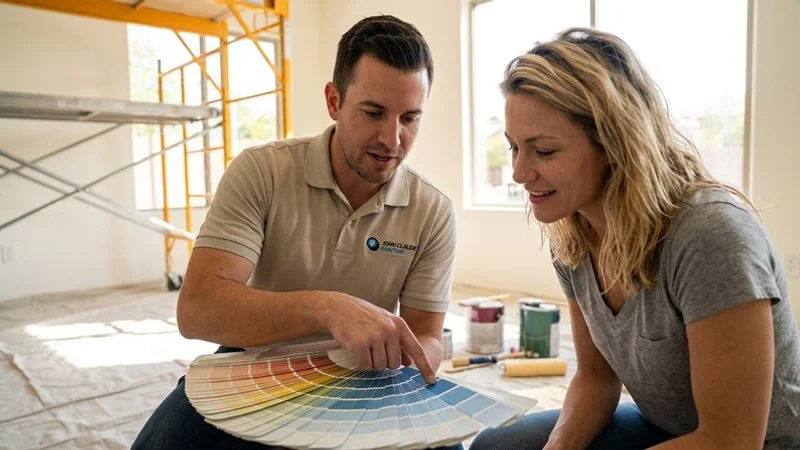
Selecting the right palette can feel overwhelming when you are juggling undertones, LRV, and lighting.
Our team offers professional color consultation to take the guesswork out of the process.
We bring large-format samples to your home, analyze your specific lighting conditions, and build a palette that flows from room to room.
Contact us for a free estimate and ask about including a color consultation with your project.
Quick Tips for Success
- Check your HOA rules — even for interiors, some window treatments or visible areas may have restrictions.
- Harmonize with flooring — you generally cannot change your tile, so ensure the wall undertone (pink, yellow, or green beige) matches the floor.
- Go one shade darker — the bright Phoenix sun will make your color appear lighter than it looks on the chip.
- Matte vs. Satin — textured walls (common in AZ) look better with matte or flat paint, which hides imperfections.
- Don’t ignore the ceiling — painting the ceiling a generic white can look stark; consider cutting your wall color by 50% for the ceiling.
You deserve a home that feels cohesive and inviting.
Get a free estimate from John Claude Painting today and let’s start transforming your space.
John Claude Painting Team
Professional Painting Contractor
Need Professional Painting Help?
Get a free, no-obligation estimate from our experienced team.
Get Free Estimate