Epoxy Garage Floor Benefits for Phoenix Homeowners
Your garage floor faces a battle every single day in the Valley of the Sun.
Between scorching tire marks, leaking oil, and the fine desert dust that coats everything, bare concrete struggles to survive here.
Temperatures inside a closed Phoenix garage can easily soar 20 to 30 degrees above the outside air temperature during summer.
That turns your parking spot into a literal oven.
Professional epoxy coatings do more than just look good.
They act as a shield for your home’s foundation.
We have seen firsthand how the right flooring system transforms a dusty, stained concrete slab into a clean extension of your living space.
Let’s look at the specific data on why this upgrade matters for Arizona homes and walk through the exact systems that handle our climate.
Why Epoxy Is Perfect for Phoenix Garages
Heat Resistance and “Hot Tire” Defense
Phoenix summers are famous for triple-digit highs.
Concrete absorbs and holds that heat.
In July, a concrete slab exposed to direct sunlight can reach surface temperatures between 135°F and 170°F.
When you drive a car that has been running on asphalt heated to 160°F or higher, your tires are incredibly hot.
Parking that hot rubber on cool or untreated concrete causes a chemical reaction called “plasticizer migration.”
The heat causes the pores of the concrete to expand while the rubber softens.
We see this cause “hot tire pickup” frequently.
This is where cheap paint or low-grade DIY coatings literally peel off the floor and stick to your tires.
Professional-grade epoxy formulations are chemically cured to resist heat levels well above 200°F.
They will not soften, peel, or transfer to your tires even in July or August.
Controlling the “Caliche” Dust
Native Arizonans know that local soil is rich in calcium carbonate, often called caliche.
This alkaline soil creates a fine, powdery dust that is notoriously difficult to manage.
Bare concrete is porous, meaning it constantly sheds microscopic dust particles (a process called dusting) and traps the desert dirt that blows in during haboobs.
This creates a never-ending cycle of sweeping that never actually gets the floor clean.
Epoxy creates a non-porous, hermetically sealed cap over your slab.
Dust cannot stick to it.
You can stop tracking that fine grit into your house with a simple sweep or squeegee.
Chemical Resistance
Your garage floor encounters harsh fluids that eat through standard concrete sealers.
Concrete is like a hard sponge that will drink up spills almost instantly.
Industrial-grade epoxy creates a barrier against:
- Motor oil and transmission fluid: These liquids bead up on the surface rather than soaking in.
- Brake fluid: This corrosive liquid wipes away without dissolving the bond.
- Gasoline: Spills evaporate or wipe clean without leaving permanent discoloration.
- Battery acid: The coating resists etching from minor splashes if cleaned promptly.
- Road Salts: While rare in the Valley, this protects vehicles returning from trips to Flagstaff or the White Mountains.
UV Stability and Discoloration
Most people assume a garage floor is safe from the sun.
However, the “apron” (the area right under the garage door) gets hammered by UV rays every time the door opens.
Phoenix has an average UV Index of 10 or 11 during summer months.
Standard epoxy can turn yellow or “amber” under this exposure within just a few months.
We utilize UV-stable topcoats, specifically polyaspartics, to prevent this chemical breakdown.
This ensures the color you choose stays consistent from the back wall all the way to the driveway.
Pest Visibility
Scorpions and crickets are a reality of desert living.
The Arizona Bark Scorpion is particularly dangerous because its natural tan color blends perfectly with stained concrete.
A grey or tan concrete floor makes it very difficult to spot these pests.
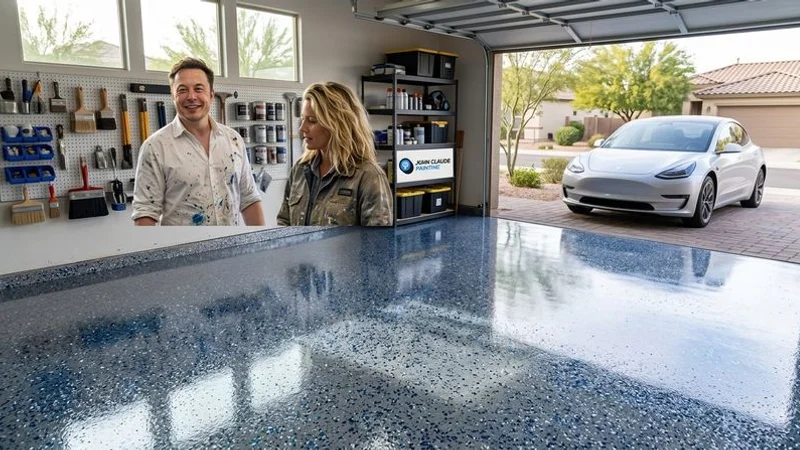
A decorative flake floor with a light base color makes it much easier to see unwanted guests before you step out of your car.
Types of Epoxy Floor Systems
Single-Layer Epoxy
This is the entry-level option often found in basic home improvement kits.
It consists of just one coat of epoxy applied directly to the concrete.
- Best for: Low-traffic storage areas or temporary fixes.
- Thickness: Thin (5-8 mils).
- Durability: 1-3 years in the Phoenix heat.
- Verdict: We generally advise against this for daily drivers in Arizona due to the heat stress.
Multi-Layer Broadcast System (The Phoenix Standard)
This is the system we install most frequently because it balances cost with extreme durability.
It relies on a chemical bond between layers to create a monolithic surface.
- Primer Coat: A low-viscosity epoxy that soaks deep into the concrete pores for adhesion.
- Base Coat: A 100% solids epoxy layer that provides the color and body.
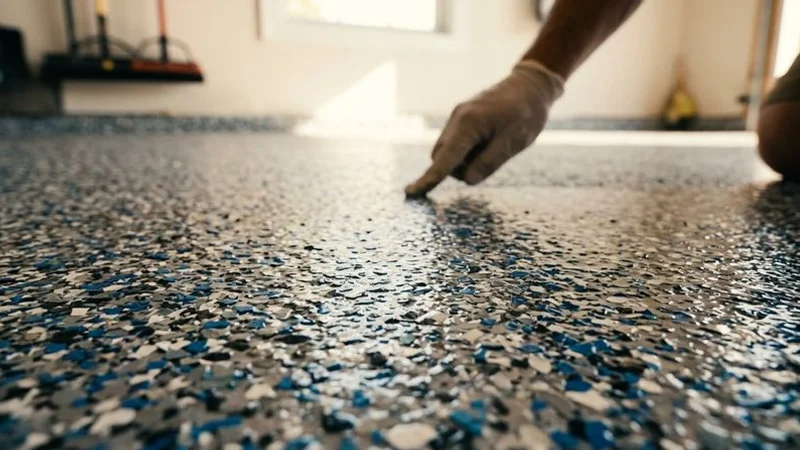
- Decorative Flake Broadcast: Vinyl chips are added to saturation, providing texture and camouflage for dirt.
- Polyaspartic Topcoat: A clear, high-performance shell that resists scratches and UV damage.
Performance Data:
| Feature | Specification | Why It Matters |
|---|---|---|
| Total Thickness | 20-30 mils | Thicker floors resist impact from dropped tools. |
| Lifespan | 15+ years | A long-term investment rather than a temporary fix. |
| Cure Time | 24 hours | Minimizes the time your garage is out of commission. |
| Texture | Orange-peel | Provides necessary grip during wet monsoon days. |
Metallic Epoxy
This option creates a flowing, 3D marbleized look that is completely unique to every floor.
It uses metallic pigments mixed into clear epoxy.
- Best for: Showrooms, “man caves,” and climate-controlled interiors.
- Visual Effect: High-gloss, glass-like finish with deep depth.
- Durability: High, though scratches are more visible than on flake floors.
- Maintenance: Requires slightly more frequent cleaning to maintain the shine.
The Installation Process
Day 1: Mechanical Preparation
We cannot stress this enough: prep is 80% of the job.
Acid etching is not sufficient for Arizona hard-troweled concrete.
Local concrete often rates between 7 and 9 on the Mohs hardness scale due to the river rock aggregate used in the mix.
Our process uses industrial grinders to achieve the correct Concrete Surface Profile (CSP) of 2 or 3.
- Diamond Grinding: We use grinders with soft-bond diamond tooling to cut through the hard concrete cap. This opens the “pores” of the slab.
- Crack Repair: Phoenix concrete often cracks due to heat shifting, similar to how stucco walls crack. We fill these with a polyurea filler that grinds smooth.
- Moisture Testing: We check for moisture vapor transmission. This is critical in new builds where concrete still holds water.
- Cleaning: Powerful vacuums remove the concrete dust to ensure a clean bonding surface.
Day 2: The Base Application
Once the concrete is open and porous, the coating begins.
- Priming: The primer is rolled out and allowed to wick into the concrete.
- Base & Broadcast: We apply the pigmented base coat and immediately broadcast the decorative flakes into the wet resin until the floor is fully covered.
- Rejection: This ensures there are no bald spots or uneven areas.
Day 3: Topcoat and Protection
- Scraping: Once the base cures, we scrape the floor flat to remove sharp flake edges.
- Vacuuming: A final clean ensures no loose chips remain.
- Clear Coat: The polyaspartic topcoat is applied. This material is distinct because it cures fast and hard.
Timeline: You can typically walk on the floor 4-6 hours after the topcoat is applied. You can park your car on it after 24-48 hours.
DIY vs. Professional: A Costly Distinction
Home improvement stores sell kits for under $300 that claim to offer the same results.
The chemistry in those boxes is fundamentally different.
Store-bought epoxy is often water-based, meaning as it dries, the water evaporates and leaves a very thin, brittle film behind.
Here is the breakdown of why professional installation is the smarter financial move for Phoenix homeowners.
| Feature | DIY Store Kit | Professional System |
|---|---|---|
| Solid Content | 40-50% (Mostly water/solvents) | 100% Solids (All epoxy) |
| Prep Method | Acid Etch (Ineffective on hard concrete) | Diamond Grind (Mechanical bond) |
| Heat Tolerance | Low (Susceptible to hot tire pickup) | Extreme (Industrial grade) |
| Film Thickness | Paper thin (3 mils) | Thick and impact resistant (25+ mils) |
| Warranties | None or very limited | 5-10 Year Guarantee |
We receive calls weekly to grind off failing DIY kits.
Paying to remove a failed coating and then install a new one costs significantly more than doing it right the first time.
Maintenance Tips for Longevity
Epoxy floors are incredibly low maintenance, but they are not self-cleaning.
Follow these simple steps to keep the shine for decades:
- Weekly Dusting: Use a soft-bristle push broom or a leaf blower. This removes grit that can act like sandpaper under car tires.
- Monthly Mopping: Use a simple solution of 5 ounces of clear ammonia per gallon of water.
- Avoid Soap Build-up: Do not use enzyme cleaners or heavy detergents. They leave a hazy film that dulls the gloss.
- Protect from Welding: If you do metalwork, use a welding blanket. Molten slag will burn the topcoat.
- Use Mats: Place a walk-off mat at the door to catch small rocks before they get ground into the floor.
A professional floor is an investment in your property value and your daily comfort.
It changes the way you use one of the largest rooms in your home.
Ready to transform your garage floor? Get a free estimate from John Claude Painting for professional epoxy floor coatings in Phoenix.
John Claude Painting Team
Professional Painting Contractor
Need Professional Painting Help?
Get a free, no-obligation estimate from our experienced team.
Get Free Estimate