Commercial Painting: How to Minimize Business Disruption
Commercial painting is often viewed as a necessary evil.
You know that peeling paint signals neglect to your customers, but closing your doors for a week to fix it feels like financial suicide.
Data from 2024 indicates that unplanned downtime costs small businesses an average of $137 to $427 per minute.
We see this friction constantly here in the Phoenix Valley.
The challenge isn’t the painting itself but the logistics of getting it done without halting your revenue stream.
Our commercial painting approach minimizes this impact by treating the project as a strategic operation rather than a simple renovation.
This guide outlines exactly how we keep your business running while we improve your facility.
Planning Your Commercial Paint Project
Start with a Technical Assessment
A standard visual check fails to catch the underlying issues that cause expensive rework.
We conduct a technical walkthrough that uses data to drive our decisions.
Specific tools are required to prevent future failures.
For instance, using a Delmhorst BD-2100 moisture meter allows us to detect hidden water issues in drywall or stucco before we apply a single drop of primer.
If moisture levels exceed 15%, painting over the surface traps the water and causes bubbling within months.
We also cross-reference this with the ASTM D4263 plastic sheet method for concrete floors to ensure no hydrostatic pressure will blow off a new coating.
This technical assessment identifies:
- High-traffic zones requiring scuff-resistant coatings like epoxy or two-part urethanes
- Sensitive assets such as servers or medical equipment needing dust-proof containment
- Logistical access for lifts and heavy materials without blocking customer paths
- HVAC intake locations to prevent fumes from circulating through the building
Create a Phased “Zone” Schedule
The most effective way to maintain operations is the “Zone Method.”
We break your floor plan into isolated sectors to keep your revenue generating areas open.
This approach keeps 80-90% of your facility fully operational at any given time.
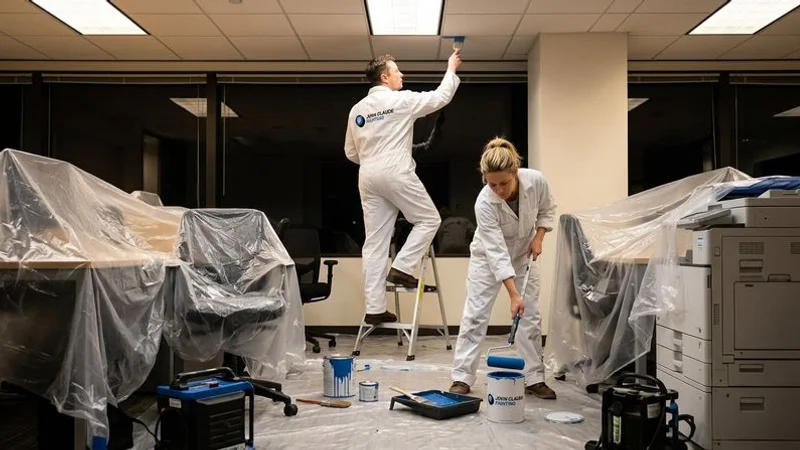
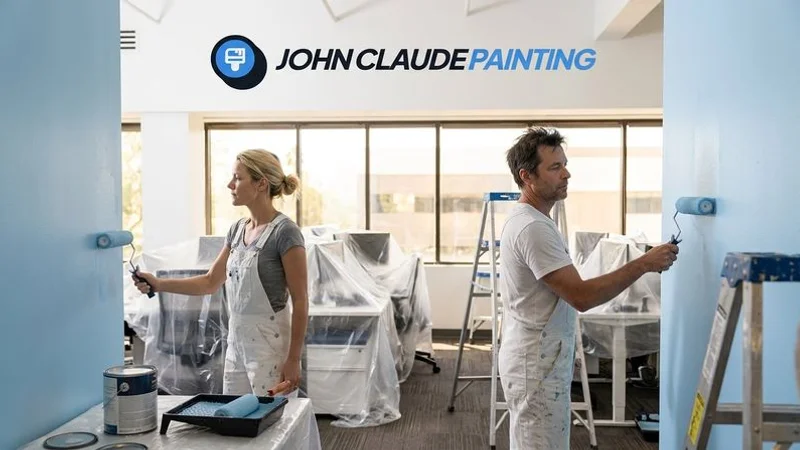
Phase 1: Prep and Containment The first step involves isolating the work zone with ZipWall dust barriers. Your team continues working in adjacent areas without disruption while we seal off the active sector.
Phase 2: The Active Cycle Our crew applies high-performance primers and finish coats. In occupied spaces, this creates a “wet zone” that is strictly off-limits until the product cures.
Phase 3: Reintegration We perform a final inspection and remove containment. The space is returned to you clean and ready for immediate use before we move to the next zone.
Scheduling Strategies
After-Hours and Weekend Work
Business owners often assume that night work comes with a massive price hike.
That is rarely the case with dedicated commercial painters who understand the need for speed.
We view after-hours access as a standard part of the job.
Working from 6 PM to 6 AM often allows crews to move 20-30% faster because they aren’t dodging employees or customers.
This efficiency usually offsets any additional labor costs.
| Business Type | Ideal Painting Window | Why It Works |
|---|---|---|
| Medical/Dental | Friday PM - Sunday PM | Allows 48 hours for curing and air scrubbing. |
| Retail Stores | 9 PM - 5 AM | Zero impact on sales hours; ready for morning open. |
| Restaurants | Mondays or 2 AM - 10 AM | Utilizes common slow days or prep times. |
| Office Spaces | 5 PM - 12 AM | Split shifts allow paint to dry before 8 AM staff arrival. |
Seasonal Timing in Phoenix
The Arizona climate dictates the success of exterior commercial projects more than any other factor.
We monitor surface temperatures strictly to ensure warranty compliance.
Painting when surface temperatures exceed 90°F causes “flash drying,” where the solvent evaporates too fast for the paint to bond.
This leads to early failure and chalking.
- October through April: This is the prime window for exterior work in the Valley as temperatures stay within the MPI (Master Painters Institute) recommended range of 50°F to 90°F.
- May through September: Interior work is ideal during these months. Your AC system helps cure the paint while we avoid the extreme outdoor heat.
- Monsoon Season (July-August): Exterior painting is risky due to unpredictable dust storms and humidity spikes that can trap moisture under the film.
Protecting Your Space
Furniture and Equipment
Standard drop cloths are not sufficient for commercial environments with electronics and high-value assets.
We use a three-tier protection system to guarantee safety.
Tier 1: Impact Protection Floors are covered with Ram Board or heavy-duty Masonite. These distinct materials protect against spills and heavy foot traffic that standard paper cannot withstand.
Tier 2: Static Seal We utilize 3M Hand-Masker systems with static-cling plastic. This technology draws dust to the plastic rather than letting it float onto your computers or merchandise.
Tier 3: Barrier Control Zip walls and magnetic door seals create a negative pressure environment. This ensures that sanding dust stays inside the work zone and does not migrate to your lobby or breakroom.
Air Quality and Low-VOC Options
Modern commercial paint technology has eliminated the “fresh paint smell” that used to trigger headaches and complaints.
We rely on verified Low-VOC (Volatile Organic Compounds) products for occupied spaces.
Top-tier lines like Sherwin-Williams ProMar 200 Zero VOC or Benjamin Moore Eco Spec are industry standards for a reason.
They meet strict LEED v4.1 emissions standards and GreenGuard Gold certification requirements.
These products offer distinct advantages:
- Same-Day Re-entry: Staff can return to the office the next morning without respiratory irritation.
- Certified Performance: They match the durability and scrubbability of traditional oil-based coatings.
- Regulatory Compliance: They satisfy strict internal air quality mandates for healthcare and educational facilities.
Communication Is Everything
Before the Project
Surprises are the enemy of business continuity.
We provide a “Look-Ahead” schedule before a single can of paint is opened.
This document outlines exactly which rooms will be offline on which dates.
It allows you to move meetings or reschedule appointments proactively.
You will also receive a clear escalation list with cell phone numbers for our project managers to bypass the office landline.
During the Project
Information needs to flow daily to keep the project on track.
Our site foreman provides a digital update at the end of every shift.
This creates a timestamped record of progress that you can access from anywhere.
- Morning Check-in: A 5-minute sync to confirm the day’s access points.
- Noise Alerts: Advance warning before noisy activities like HEPA vacuuming or mechanical sanding.
- Visual Logs: Photos of completed areas sent directly to your phone or email.
- Immediate flags: If we find a maintenance issue (like a leak or mold), you know about it instantly.
Tips for Property Managers
Managing a portfolio of properties requires a different strategy than a single-location business.
We have found that standardization and tax awareness are the biggest money savers for facility managers.
- Leverage Section 179: Under current tax laws, interior painting for commercial buildings often qualifies as “Qualified Improvement Property” (QIP). This allows you to deduct 100% of the cost in the first year rather than depreciating it over 39 years.
- Standardize Your Spec: Select one specific color palette and product line (e.g., “Swiss Coffee” in Eggshell) for all units. This allows for quick touch-ups without repainting entire walls.
- Bundle Your Bid: Awarding 10 units to one contractor often lowers the price per unit by 15-20% due to reduced mobilization costs.
- Understand CAM Charges: Categorize painting correctly. Exterior painting is often a Common Area Maintenance (CAM) expense recoverable from tenants.
- Audit Your Warranties: Ensure your contractor provides a written labor and material warranty that stays with the building.
Our Commercial Painting Approach
John Claude Painting was established to provide homeowners and businesses with professional painting solutions centered on reliability and superior craftsmanship.
We know that in the commercial world, time is money.
Our teams are structured to work around your clock so you never have to stop working.
Contact us for a free commercial painting estimate and let’s build a schedule that protects your bottom line while we protect your building.
John Claude Painting Team
Professional Painting Contractor
Need Professional Painting Help?
Get a free, no-obligation estimate from our experienced team.
Get Free Estimate