When Is the Best Time for Exterior Painting in Phoenix?
Overview
You have likely seen paint peeling off a neighbor’s house just months after a renovation.
This usually happens because the work was done during the wrong season.
In Phoenix, timing is actually a matter of chemistry rather than just convenience.
Our team at John Claude Painting has seen firsthand how the desert sun interacts with curing agents in premium paints.
We know that applying paint when the surface temperature exceeds manufacturer limits causes “flash drying.”
This prevents the binder from adhering properly to your stucco.
So, I’m going to break down the exact climatic windows for successful exterior painting and explain the specific seasonal risks you need to avoid.
The “Golden Window” for Phoenix Painting
The consensus among local experts is clear regarding the calendar.
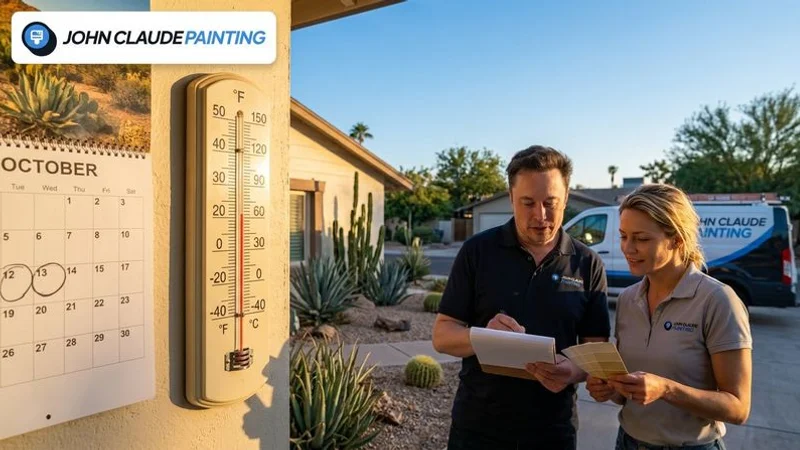
Mid-October through April offers the ideal conditions for exterior painting in the Valley.
During these months, daytime highs typically range between 60°F and 85°F.
This temperature range allows acrylic and latex paints to form a durable film without drying too quickly.
However, specific months within this window offer different advantages:
- Late October to November: These are arguably the best months. The risk of rain is statistically low, and the daily temperature swing is manageable.
- December to February: Painting is possible, but we must monitor overnight lows. Most premium paints require temperatures to remain above 35°F for 24 hours to cure.
- March to April: This is the spring rush. Conditions are perfect, but contractor schedules fill up weeks in advance due to the high demand.
The Hidden Dangers of Summer Painting
Many homeowners assume that because paint dries faster in heat, summer is a fine time to paint.
That assumption is the primary cause of premature paint failure in Arizona.
Surface Temperature vs. Air Temperature
The air temperature might be 105°F, but your south-facing stucco wall is likely much hotter.
A 2022 infrared study on construction materials showed that dark stucco surfaces in direct sunlight can reach temperatures 40°F to 50°F higher than the ambient air.
When paint hits a 150°F surface, the solvents evaporate instantly.
This process, known as “flash drying,” prevents the paint from bonding into the pores of the masonry.
The result is a coat that sits on top of the wall like a sticker rather than bonding to it.
Navigating the Monsoon Season
The timeline between June 15 and September 30 presents a completely different set of challenges.
Humidity becomes the enemy during these months.
While we are famous for “dry heat,” the dew point spikes significantly during the monsoon.
Why Humidity Matters
High humidity prevents water-based latex paints from releasing moisture efficiently.
If a storm rolls in while paint is still tacky, you risk water spotting or surfactant leaching, which looks like soapy streaks running down your walls.
The Dust Factor
Haboobs (dust storms) are a major risk during this season.
Wind-driven dust can embed itself into wet paint up to four hours after application.
We closely monitor National Weather Service alerts during these months to ensure we never start a section that cannot dry before the winds pick up.
Comparison: Ideal Conditions vs. Phoenix Extremes
Making the right choice requires looking at the data side-by-side.
Here is how standard paint specifications compare to what we actually deal with in the Valley.
| Feature | Manufacturer Ideal Spec | Phoenix Summer Reality | Phoenix “Golden Window” |
|---|---|---|---|
| Air Temperature | 50°F - 90°F | 100°F - 115°F | 65°F - 85°F |
| Surface Temperature | Below 90°F | 140°F - 170°F | 70°F - 90°F |
| Relative Humidity | 40% - 50% | 10% (June) / 60%+ (Aug) | 20% - 35% |
| Drying Time (Touch) | 1-2 Hours | 10-15 Minutes (Too Fast) | 45-90 Minutes |
Desert-Climate Considerations
Arizona homeowners face unique considerations that don’t apply in other parts of the country.
Local geography and building materials dictate our approach:
- UV Intensity: The UV index in Phoenix hits 11+ regularly. This radiation breaks down the chemical bonds in cheap paint binders. We recommend 100% acrylic formulas, such as Dunn-Edwards Evershield, which are specifically formulated for Southwest UV exposure.
- Thermal Shock: Your home expands and contracts drastically between the 110°F day and the 80°F night. Rigid paints will crack under this stress. You need an elastomeric or high-flexibility coating that moves with the stucco.
- Alkalinity: Stucco is naturally alkaline (high pH). Fresh stucco repairs can burn through standard primers. We test the pH levels of masonry surfaces before applying the primer coat.
Making the Right Choice
The best approach depends on your specific situation.
Waiting for the perfect weather is not always an option if you are selling your home or facing HOA fines.
Strategies for Off-Peak Painting
If you must paint during hotter months, we adjust our technique:
- Chase the Shade: We schedule work to follow the shade around the house, ensuring we are never painting on a sun-baked wall.
- AM Scheduling: Work starts at sunrise and stops by 1:00 PM to avoid peak heat.
- Additives: We can use specialized extenders that slow down the drying time of the paint, allowing it to level out properly even in lower humidity.
At John Claude Painting, we provide free, no-obligation estimates that include a thorough assessment of your home’s condition and honest recommendations for the best approach. Contact us today to schedule your free estimate.
Why Choose John Claude Painting
Finding a contractor who understands these scientific nuances is critical.
We focus on longevity, not just the immediate appearance.
- Licensed and insured professionals: We carry full liability and workers’ compensation coverage for your peace of mind.
- 10+ years of Phoenix-specific experience: We know how local stucco ages and which cracks are structural versus cosmetic.
- Premium products: We exclusively use top-tier lines from Sherwin-Williams and Dunn-Edwards that are rated for desert climates.
- Meticulous surface preparation: We spend as much time washing, trenching, and patching as we do painting.
- Free estimates with no obligation: You get a detailed breakdown of costs and timelines upfront.
Ready to get started? Request your free estimate or call us at 602-737-1234.
John Claude Painting Team
Professional Painting Contractor
Need Professional Painting Help?
Get a free, no-obligation estimate from our experienced team.
Get Free Estimate